How to Become a Software Architect
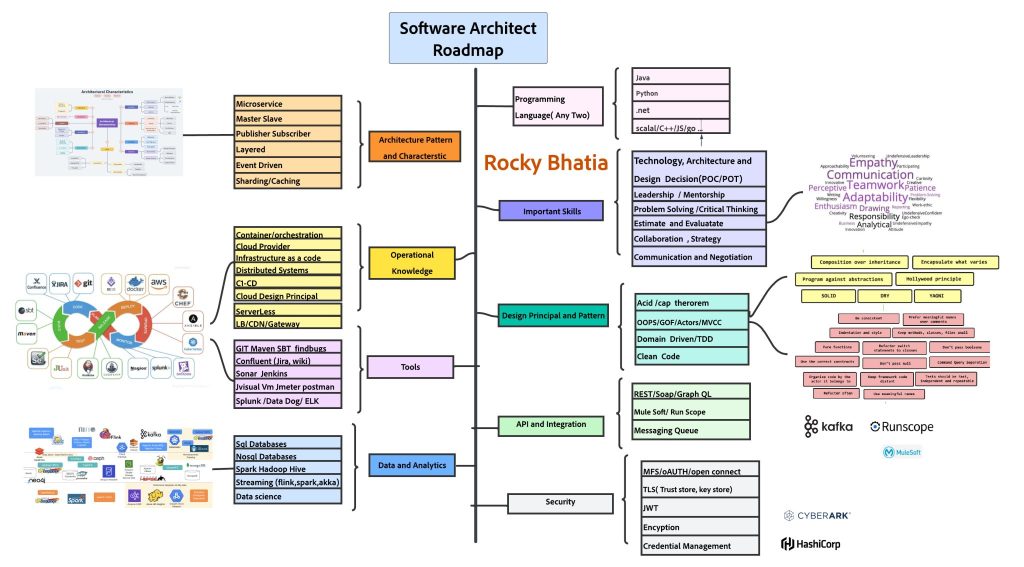
Being a good architect is achieved by applying and implementing more than reading.
After getting 100’s DM on the guidance of becoming a software architect, Based on my working experience, I have created the below roadmap.
The position of a software architect requires a profound knowledge of software functionality, performance, viability, scalability, comprehensibility, security, and technological constraints.
Language :
To start your career as a Software Architect, you should have a sound knowledge of programming languages & frameworks.
Architects lead the team of developers, collaborate with other groups, review code, etc. hence one must have a thorough understanding of programming concepts and paradigms.
Architecture Pattern and Style :
In software engineering, a design pattern is a general, reusable solution for solving a common problem when designing an application or system.
- Microservice
- Event Driven
- Layered
- Master-Slave
- Publisher Subscriber
Design Principal and Pattern
A design pattern is more of a template to approach the problem.
- Design Pattern – GOF , OOPS principle, programming Paradigms.
- ACID (Atomicity, Consistency, Isolation, Durability)
- CAP (Consistency, Availability, Partition Tolerance)
- SOLID
- Domain-driven design
Important Skills :
An architect takes all Technology, Architecture, and Design Decisions and conducts the POT and POC.
He mentors technical teams and promotes quality standards and the right vision of the product. As a result, they should be able to win authority and respect.
An architect communicates with stakeholders, business analysts, and engineers, explaining the benefits of employing certain technologies or applying a specific pattern. He manages the system design and should be able to identify risks timely.
Operational Knowledge – one should have working experience in some of the following areas to make a better decision.
- Containers
- IAAS
- Serverless
- CI/CD
- Cloud design
- Distributed computing
- LB
- Security Gateway
Data and Analytics: One should have strong hands with the some of the following tools
- SQL and NoSQL databases
- Batch processing ( Spark ,Hadoop)
- Stream Processing ( flink, spark streaming ,storm)
- Warehouse (hive, snowflake )
Tools – Hands on experience with Important tools like
- git, maven,check style,find bugs,
- Jira, sonar, jenkins
- JMeter ,splunk etc
API and Integration – Rest/Soap/graphql and api management like mule soft, messaging queues .
Security – Security aspects related to Certificate ,credential data at rest ,data in motion
Architects can further be divided into the following categories(Future Post) : Enterprise /Solution /Cloud Architect/Big Data Architect
Writter: Rocky Bhatia via LinkedIn
Posted By -

Saifullah Siddique
Subscribe to our newsletter for social resources
Join 70,000+ professionals and become a better social media marketer. Get social media resources and tips in your inbox weekly.
Comments